Saturday, September 29, 2007

Aha ! "$100 laptop" ... uh? yeah, sure ?!!?!

Couple of weeks ago, browsing the local paper (QC Times), I found an article in the business section about the prices of the laptops from the OLPC project.

I'm not specifically following up this project, but as usually happens ... suddenly I see it everywhere ... the articles or news just pop at me. In a previous posting I talked about the difference in price, at the beginning I thought that will be just a Latin America overhead cost ($100 + taxes + any other government fee). However seems that the $100 is just a label. Here is an extract of the article:

" ... Leaders of the non profit One Laptop Per Child that was spun out MIT acknowledged Friday that the devices are now slated to cost $188 when mass production begins this fall. The last price the non profit announced was $176; it described $100 as a long term goal."

I am glad that at least these change in price is acknowledge now, and they do not force to produce something with less capabilities than the ones needed. You know "the cheap ...in the long run costs double ...". However the article also mentions a reality for the governments who budget for $100 per laptop and it might be costing almost double. I will not be surprised if some of the interested just drop their place in the waiting list.

Back in 2005 was reported that the laptop will be "... A 500-megahertz processor (that was fast in the 1990s but slow by today’s standards) by Advanced Micro Devices Inc. and flash memory instead of a hard drive with moving parts. To save on software costs, the laptops would run the freely available Linux operating system instead of Windows.
The computers would be able to connect to Wi-Fi wireless networks and be part of “mesh” networks in which each laptop would relay data to and from other devices, reducing the need for expensive base stations. Plans call for the machines to have four USB ports for multimedia and data storage.'

The 2007 article reminds us that the the laptops will still feature:
  • open-source & intuitive interface
  • sunlight readable display
  • very low power consumption (and pull cord for recharging by hand), and
  • built-in wireless networking

Source: Quad-City Times - Business Section - Page A-20 - Sep 16, 2007

Sunday, August 26, 2007

One laptop Per Child


I have in my pocket a small article about the project One laptop Per Child (OLPC), that I meant to post from long time ago. The wrinkled article talks more about the design of the laptop (very nice in my opinion) and its designer (Yves Behar).

But during my time in Buenos Aires (January 2007), reading a magazine while I was accompanying my mother to her doctor's appointment, I stumble with another article about this project and its implementation in Argentina. I thought .. ok is not accident too much OLPC ... let's investigate more about this topic !

I read first the article in Argentina (Information Technology, Magazine # 116, Page 6, Dec 2006) and they where mentioning that Intel offered an alternative (the ClassMate) to the laptop developed by the MIT for the project (the X0-1).

When I came back home and had access to the Internet I went back to the source, the OLPC web page .

The original idea of the project was develop a 100$US that will be distributed to children from developing nations. Read more about the vission progress at the project website, too.

The 100 dollars, became kind of a label. Affordable is the rationale, but so far for Argentina that price will represent ~138 $US (I don't know the reason for the increase). They are not decided yet about if go with the Intel or MIT's version. Our uruguyan neighbours according to the OLPC committed to the project on Dec 2006.

In Argentina the OLPC project is overseed by the organism called educ.ar

According with an interview (in spanish) published in Aug 2007 with, Laura Serra, the project director of educ.ar; she mentioned that the Argentinean government position to see if they will join the project was:

  • transparency in the purchase process (we had some ugly experiences with corruption between government and prestigious companies as IBM),
  • Have access to a reasonable amount of computers to do a pilot test,
  • Have access to a final product to explore their definitive features.
Some issues regarding the implementation of the pilot (i.e. some adapters were not what was needed in Argentina, having a very earlier version to test) are making the piloting smaller as initially thought.

This article in the OLPC website point some concerns about implementation. Even though the interviewee is not the current education minister, I am sure that are still worries in the government minds.

Seems that a quick and smooth implementation will still take some time at least in Argentina.

After so many years in Accenture I should know better that is not the object but the implementation the key for success (sigh !).

Monday, June 11, 2007

Web 2.0 & XML

I like this video because in less than five minutes provides a overall explanation about some of the possibilities of this new stage of the web and also new issues to consider.
The web 2.0 is a term coined - according to wikipedia - by O'Reilly Media in 2003. The web 2.o refers to the evolution of the web not in its technology but about how the users use it, interact with each other and build knowledge together. Web 2.0 is more participative and less hierarchical.

Thanks to Antonia Chan for pointing out the video in this sea of information called web, whatever version we are in.

Wednesday, February 21, 2007

Forgive me, readers, for I have sinned ...

When blogging, one of the mistakes that need to be avoided first is "do not post". Is not rocket science ... the frequency is a key element. It doesn't have to be daily but need to be c-o-n-s-t-a-n-t. As you probably realized I made the mistake.

I'm not very good at keeping paper-based journals, so it can be applied to blog. In fact, originally I thought about this blog more as a repository of ideas and cool links to share than a detailed an up-to-date electronic journal.

However, I know that the user (reader in this case) might be disappointed in the last posting can be tested with the carbon 14 test !
I admit that the frequency is key, so my new commitment with you is that my posting will be at least bi-weekly.

Of course after all the euphoria probably I will post more frequently in the next days.

I found this very interesting article wrtitten by John Chow about the 10 blogging mistakes to avoid:
Blogging Mistake #1 - Not Updating
Blogging Mistake #2 - Blogging Only For Money
Blogging Mistake #3 - Rushing a Post
Blogging Mistake #4 - Not Being Personal
Blogging Mistake #5 - Being a Copycat
Blogging Mistake #6 - Not Replying To Comments
Blogging Mistake #7 - Not Giving a Full Feed RSS
Blogging Mistake #8 - Not Reaching Out To Other Bloggers
Blogging Mistake #9 - Writing For Google Instead Of People

The Blogging Mistake #10 (– Not Reading John Chow dot Com) is arguable ;-P

More info at http://www.johnchow.com/10-blogging-mistakes-to-avoid/

Saturday, April 15, 2006

Where are you ?

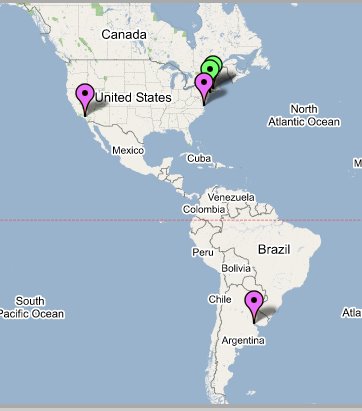
In my 'GPS, Geocode & Googlemaps for Learning' class as an icebreaker we locate ourselves in an interactive map. Check it out !
http://www.zeesource.net/maps/moremap.do?group=3619

In addition to the obvious benefits to teach geography, it think that this is just a really cool icebreaker for any type of training :-)

Friday, April 07, 2006

Architecture & Learning - Part 2

I found other very interesting material aboput architecture, layout, museums and learning at
http://www.art-works.org.uk/research/spaceforlearning0.shtml

The name of the project is ' Space for Learning' and in the URL above you can find the handbook of the project.

Space for Learning : A Handbook for Education Spaces in Museums, Heritage Sites and Discovery Centres is a collaborative research project investigating learning spaces in museums, archives and libraries, historic houses and buildings, heritage sites (industrial, archaeological and natural), architecture and science centres, children's museums and discovery centres across the UK

According to their website, the Artworks programme, is devised and funded by the Clore Duffield Foundation as part of its support for visual arts education in the UK

Thursday, April 06, 2006

Architecture & Learning

Helping Suzanne with her project of the caves in Tanga (Tanzania) for my class EDTEC 671, I discover another area that is really interesting.

Is about museums layouts to enable, support and even enhance the learning experience .... this crossroads among architecture, graphic design & instructional design is amazing.

In the The Association of Science-Technology Centers (ASTC) website ... great site by the way ... I found a very interesting article titled "The Importance of Place" by Rob Semper.

Here is how starts:
" While learning is often thought to be a process of the mind, much of what actually occurs during the learning process is predicated by features of the learner’s environment. The variety of stimuli, the social aspect of the setting, the spatial context, and even the amount of ambient light and sound all affect the learning experience. Even the external architecture of the building sends a strong message about visitor expectations."

Want to read more ? Go to
http://www.astc.org/resource/education/learning_semper.htm

Saturday, April 01, 2006

My first attempt with Podcasting

Here I am, in my Saturday Podcasting class.

I really enjoyed learn how to create Podcast, and as many of the courses in my MA Educational Technology program:
1) Increased my awareness of the 'behind-the-scene' work
2) Reinforced the fact that 'good intentions; do not make -necessarily - good educational products
3) Helped me to find new areas to be passionate about

Our teacher (Bernie Dodge) said that make podcasts is like make pancakes, no matter how much effort you put, always the fisrt one will not be perfect ... however as much as you practice ... you will master the art (pancakes & podcasts).

Here is my first pancake (Bernie Dodge dixit):
A 2:50' Podcast about bad reasons of why parents don't talk to their kids about drugs.
Download the Podcast

I re-purposed the text I found in one interesting adversitement about the same topic.
I wrote to them to get the permission to use the wording ... I have not answer yet ... so this is purely for educational purposes.

A special 'Thank You' to Margaret, Bindu, John, Suzi & Aaron for their collaboration.

The organization is called The Partnership for a Drug-Free America, their website is http://www.drugfree.org/, I like very much the way they approach the topic.